
Which PET Preform Matches Which Bottle? Preform Weight, Neck & Bottle Size Guide
Many new blow‑molding plant owners and packaging buyers ask the same question: Which PET preform do I need for my target bottle?
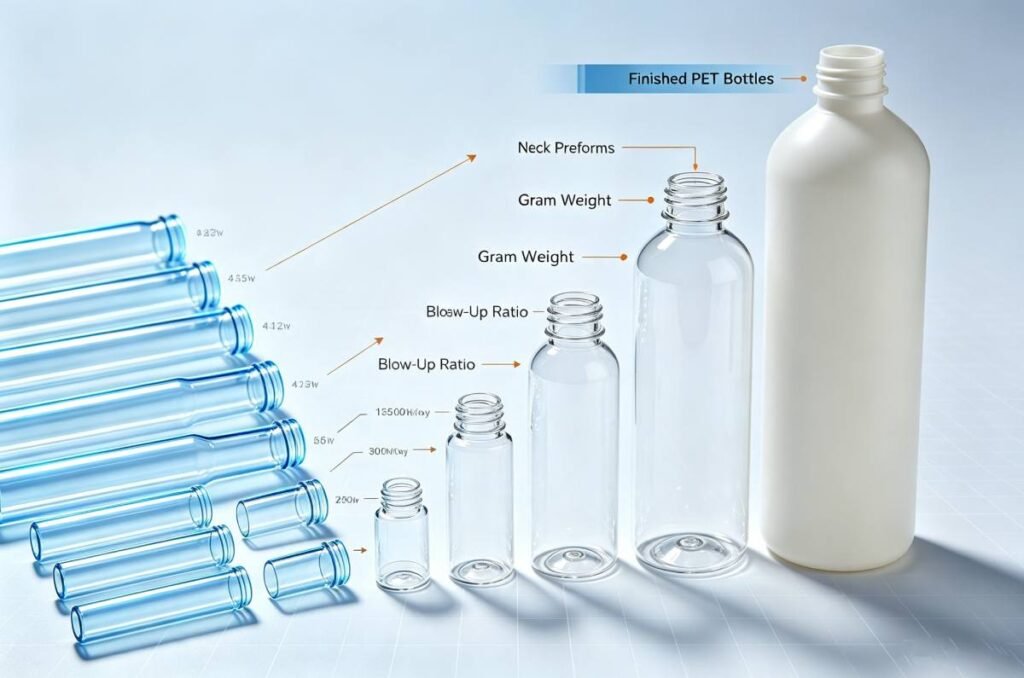
It is not as simple as “one preform for one bottle”. One single preform can be stretched into multiple bottle shapes within a reasonable expansion ratio. Meanwhile, one bottle design can often be blown from several different‑weight preforms, each delivering different wall thickness, strength and cost.
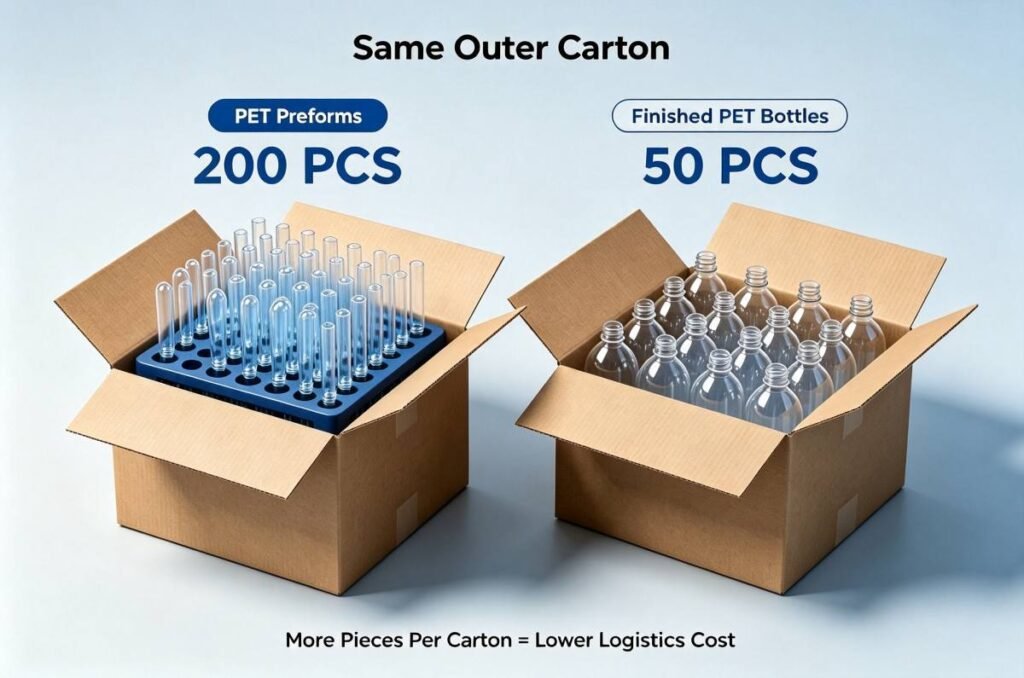
More importantly: importing preforms instead of finished bottles changes your whole supply chain. You only need a blow‑molding machine locally, no injection molding workshop required. It cuts ocean freight, container loading cost and warehouse pressure dramatically.
Important note: Commercial preforms available for separate sale are almost exclusively made of PET. Resins like HDPE are mainly processed by extrusion blow molding, not two‑step stretch blow from standalone preforms.
In PET blow molding production, many packaging buyers and factory operators encounter a common confusing problem:
Three Core Parameters That Link Preforms To Finished Bottles
Three non‑negotiable features define whether a preform can work for your bottle: neck thread standard, preform gram weight, and maximum blow‑up ratio.
1. Neck Thread (Cannot Be Changed After Production)
The thread on a PET preform is fixed. Blow molding does not change the bottle neck at all.
- 28‑400 preform → only makes bottles with 28‑400 mouth
- 38‑400 preform → only makes bottles with 38‑400 mouth
- 45‑400 preform → only makes bottles with 45‑400 wide mouth
No matter what shape the bottle body is, the cap is decided by the preform’s neck finish. This is the first thing to confirm before any other calculation.
2. Gram Weight (Total PET Material Available For Stretching)
The gram weight is the total mass of PET resin in one preform. It sets the upper limit of material you can spread across your bottle walls.
- Light‑weight preform: limited material → thin bottle walls, for disposable, low‑stress packaging
- Medium‑weight preform: balanced material → standard wall thickness, good stacking and drop resistance
- Heavy‑weight preform: plenty of material → thick, rigid walls for export, long transit, large‑volume bottles
As we covered in our earlier article: different‑gram preforms can blow bottles of the same volume, but wall thickness will differ.
3. Blow‑Up Ratio (Maximum Stretch Limit)
This is the technical red line every blow molder must respect. The blow‑up ratio is how many times the preform’s body diameter can be expanded.
- Safe recommended ratio: 3:1 ~ 4:1
- Maximum practical limit: around 5:1
- Over‑stretching: uneven thin walls, pin‑holes, silver streaks and high reject rates
You cannot turn a slim small preform into an extremely wide, large‑diameter bottle, no matter how high your air pressure is.
Reference Matching Table: Bottle Volume ↔ Recommended Preform Specifications
This table is for general industry reference, not absolute fixed values. Actual preform gram weight should also consider your target wall thickness, transport conditions and filling method (hot fill / cold fill).
| Target Bottle Volume | Common Neck | Typical Preform Gram Range | Typical Bottle Applications |
|---|---|---|---|
| 100‑250ml | 28‑400 | 12‑18g | Sample bottles, mini juice, cosmetic liquids |
| 300‑600ml | 28‑400 /38‑400 | 18‑24g | Drinking water, regular juice, kefir, sauces |
| 750‑1500ml | 38‑400 | 25‑36g | Large beverage bottles, edible vinegar, liquid condiments |
| 2L‑3L | 38‑400 /45‑400 | 38‑55g | Cooking oil, big‑batch fruit drinks, household cleaners |
| 4L‑5L | 45‑400 | 58‑85g | Large oil jugs, bulk drinking water, industrial liquids |
The Big Business Advantage: Import Preforms, Not Finished Bottles
This is the most valuable insight for overseas investors and packaging factories, and many buyers have not fully realized it yet.
How much space can you save?
A 40HQ container can hold around:
- ~ 80,000 finished empty 1L PET bottles
- ~ 650,000 pieces of corresponding 24g PET preforms
That’s 8 times more product in the same container! Ocean freight per unit drops sharply.
Your local factory only needs blow molding, not injection molding
Injection molding for PET preforms demands huge investment: large injection machines, expensive hot‑runner molds, skilled technicians, stable power supply, and high maintenance costs.
Blow molding is much simpler:
- Small‑to‑medium semi‑automatic blow machines are affordable and easy to operate
- Local workers can master basic operation quickly
- You can scale production gradually without heavy upfront investment in injection equipment
- Storage space for preforms is far smaller than for empty finished bottles
When preforms are NOT the right choice
We also need to be honest about limits, just like the kefir jug with integrated handle in your photo:
- Bottles with one‑piece built‑in handles: difficult for standard two‑step PET blow molding; HDPE extrusion blow is still mainstream
- Very special irregular, deep‑folded shapes: may need custom, high‑cost preform molds
- Super‑thin disposable bottles at the lowest possible cost: local injection‑blow may compete on price
Common Mistakes When Matching Preforms To Bottles
- Mistake 1: Choosing the wrong neck thread. The bottle body can change, the neck cannot.
- Mistake 2: Buying too‑light preforms for export‑bound bottles. Thin walls cause high breakage during long sea transport.
- Mistake 3: Trying to over‑stretch small preforms into very wide bottles, ignoring blow‑up ratio limits.
- Mistake 4: Thinking one preform can make every bottle size. The gram weight must match the total surface area of your finished bottle.
Frequently Asked Questions
Q1: Can one preform mold blow many different bottle shapes?
Yes, as long as the neck is the same and the blow‑up ratio stays within safe limits. The same 38‑400,24g preform can make round bottles, square bottles, or slightly contoured bottles for 1L volume.
Q2: Can a small semi‑automatic blow machine work with large‑size, heavy‑gram preforms for 4‑5L oil bottles?
Yes, but you need to select a blow machine model designed for big preforms. Not all small blowers can heat and stretch heavy, long preforms properly.
Q3: If I have an existing bottle sample, can you tell which preform I need?
Absolutely. Send us your bottle sample or full 3D drawing. Our technical team can calculate the required preform gram weight and recommend the correct neck finish for your project.
Q4: Is HDPE preform the same as PET preform?
No. HDPE is normally processed by extrusion blow molding. There is no commercial two‑step HDPE preform sold on the market. The term “PET preform” always refers to preforms for stretch blow molding.
Q5: Is it cheaper to buy finished bottles locally or import preforms from China?
For medium‑to‑large volumes, preforms are almost always more cost‑effective once you factor in container load rate and shipping costs. We can provide a simple cost comparison for you.
Conclusion
Selecting the correct PET preform is not guesswork. It depends on three fundamentals: neck thread, gram weight, and blow‑up ratio.
Beyond the technical side, preforms open a smarter packaging business model for global entrepreneurs: source high‑quality preforms in bulk, do only blow‑molding locally, and cut your overall supply‑chain cost significantly.
Whether you are starting a new blow‑molding plant or looking to replace your finished‑bottle suppliers, we can offer professional preform selection, sample testing and bulk supply of standard & custom PET preforms. Contact our team for a tailored solution.
This article fully explains why different gram preforms can produce the same volume bottles, the core differences between light-weight and heavy-weight preforms, applicable scenarios, quality risks, and professional selection guidance for blow molding factories and packaging purchasers.
Get Your Wholesale Packaging Bottle Inquiry Solution
Tell us your requirement for capacity, color, logo printing. We will reply you within 24 working hours.